China Top 10 Construction Container Manufacturers 2026
China’s construction container industry is entering 2026 with stronger demand for practical, reusable site accommodation. Contractors need more than a steel box. They need safe offices, dormitories, storage rooms, sanitation units, and weather-resistant spaces that arrive ready for work.
This guide examines China’s top 10 construction container manufacturers through clear, practical criteria. These include product engineering, material quality, welding consistency, insulation performance, customization, factory capacity, delivery experience, and after-sales support. A reliable manufacturer should provide traceable specifications, realistic production timelines, and documentation for regional building requirements. Site conditions also matter. A coastal project may require stronger corrosion protection, while a cold-region camp may need thicker insulation and improved heating compatibility.
Details reveal the difference. Check panel joints, door alignment, floor loading, drainage points, and roof sealing. Ask how suppliers test repeated assembly and transport. Look beyond attractive catalog images.
The ranking is not absolute. Manufacturer performance can change with ownership, capacity, raw-material prices, or project scale. Some companies excel at standardized units but struggle with complex layouts. Others offer impressive customization, yet their lead times may be less predictable. That weakness deserves attention.
Drawing on industry experience, supplier research, and practical purchasing considerations, this overview aims to support informed decisions. It does not replace factory inspections or contract review. Instead, it offers a dependable starting point for comparing construction containers in 2026. Readers should verify current certifications, specifications, references, and delivery commitments before placing an order. Small details often decide whether a site solution performs well after installation.
China’s Top 10 Construction Container Manufacturers in 2026
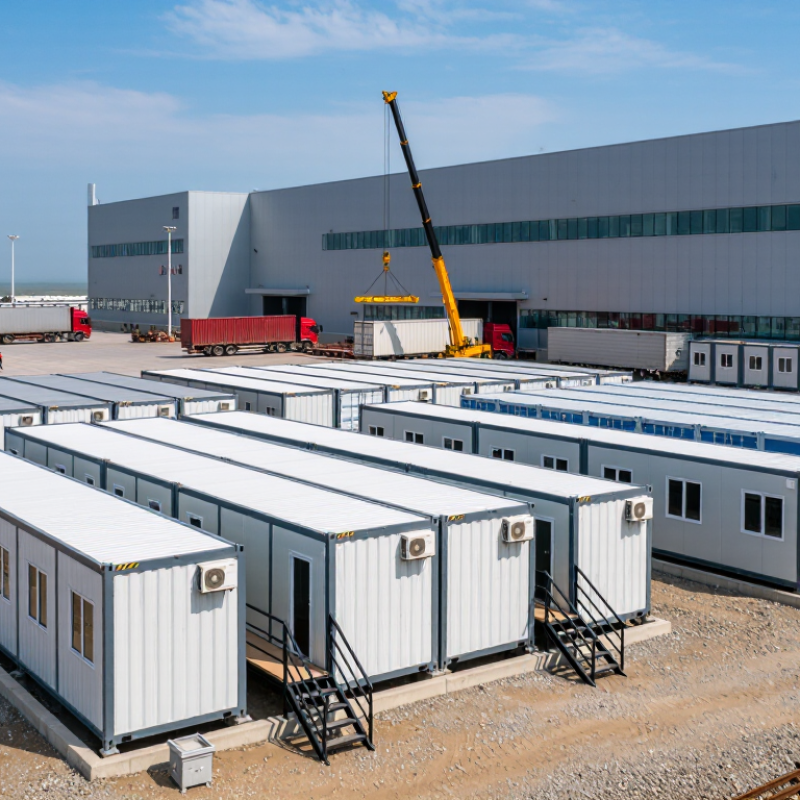
China’s Top 10 Construction Container Manufacturers in 2026 reflect a fast-changing modular building market. These manufacturers serve construction sites, worker accommodation projects, offices, storage units, and temporary facilities. Their products commonly use welded steel frames, insulated wall panels, fire-resistant materials, and standardized 20-foot dimensions.
A practical evaluation should examine more than catalog photos. I would check frame thickness, weld consistency, roof drainage, floor loading, and door alignment. Factory visits can reveal details that brochures often miss. Some workshops use automated cutting, while others rely heavily on skilled manual work. Both methods can succeed, but inspection records matter. Reliable manufacturers provide material certificates, production drawings, sample units, and clear delivery schedules. They should also explain regional wind, snow, humidity, and transport requirements before quoting.
The top ten should not be judged by price alone. Cheap panels may reduce comfort and service life. Higher insulation performance can lower energy use in occupied units. However, specifications are sometimes overstated. This ranking therefore considers manufacturing experience, quality control, customization ability, export coordination, and after-sales response. The assessment is not flawless. Supplier capacity can change during peak seasons, and a strong factory may still have weak communication. Buyers should request recent project evidence, inspect a sample container, and confirm every technical detail in writing. Small omissions become expensive on busy construction sites.
How Construction Container Manufacturers Are Selected and Ranked
Selecting China’s top construction container manufacturers in 2026 requires more than comparing catalog prices. A reliable ranking begins with verified factory capability, production experience, and documented project performance. Auditors should examine welding quality, steel thickness, corrosion protection, insulation, and floor load capacity. A sample unit should be inspected, not merely photographed. Small details matter, such as sealed roof joints and clean electrical routing.
Technical performance receives substantial weight.
Manufacturers should provide test records for fire resistance, wind loads, thermal insulation, and structural safety. Evaluators should also review design flexibility, including modular layouts, sanitation units, offices, and temporary accommodation. Delivery records reveal practical competence. A factory that meets a promised schedule during peak demand deserves stronger consideration. However, a low price may hide thinner panels, weak fittings, or costly site repairs.
The ranking should include after-sales response, spare-part access, installation guidance, and warranty clarity. Factory audits, customer interviews, and third-party documents create stronger evidence than promotional claims. Yet the method is not perfect. Project conditions differ widely, and one successful installation cannot prove consistent quality. Currency changes and freight costs may also distort comparisons. For this reason, each manufacturer should be scored against the same criteria, with evidence dated and checked before publication. Some impressive data may still need a second inspection.
Product Types, Technologies, and Services Offered by the Top Manufacturers
China’s top construction container manufacturers in 2026 provide more than basic steel boxes. Their product ranges include site offices, portable accommodation, guard rooms, sanitary units, storage containers, and modular classrooms. Some factories also produce expandable and flat-pack units for projects with limited transport access. A ten-minute loading check can prevent costly delays.
Current designs often use galvanized steel frames, insulated sandwich panels, fire-resistant materials, and corrosion-protection coatings. Manufacturers are adding smart temperature sensors, energy-saving lighting, solar-ready roofs, and digital access systems. Factory welding robots improve consistency, while computer-aided design supports customized layouts. Yet technology is not everything. Poor installation can still cause leaks, heat loss, or uneven floors.
Experienced suppliers usually offer site surveys, structural calculations, layout planning, transport coordination, installation, and after-sales maintenance. They may provide replacement panels, electrical inspections, and user training after delivery. Reliable manufacturers explain load limits and local compliance requirements instead of promising universal solutions. This matters in coastal areas, where salt air attacks exposed metal quickly. Quality records, material certificates, production photos, and third-party inspections strengthen buyer confidence. One weakness remains: delivery estimates are sometimes optimistic. Buyers should confirm foundation conditions, crane access, drainage, and actual lead times before signing.
China Top 10 Construction Container Manufacturers 2026
Standard ISO-based external dimensions of commonly supplied construction container configurations.
Construction container suppliers commonly provide 20-foot and 40-foot units in standard and high-cube formats.
High-cube containers provide an additional 305 mm of external height, supporting improved headroom and insulation space.
The dimensions shown are nominal ISO external dimensions in metres.
Market Comparison: Quality, Pricing, Customization, and Delivery
China Top 10 Construction Container Manufacturers 2026
Comparing China’s leading construction container manufacturers requires more than checking catalog prices. Quality begins with steel thickness, weld consistency, corrosion protection, and panel insulation. A reliable supplier should provide material certificates, production photos, and inspection records. During site evaluations, check door alignment, floor loading, roof drainage, and seal performance. Small defects become expensive after repeated relocation.
Pricing varies with size, insulation, electrical systems, and interior finishes. A low quotation may exclude transport, lifting, wiring, or local compliance adjustments. Request a complete cost sheet for a fair comparison. Customization is often practical, from office partitions to sanitary modules and reinforced floors. However, every extra socket, window, or partition can affect production time. Too many changes create confusion.
Delivery performance depends on design approval, material availability, factory capacity, and port schedules. Standard units may leave the factory within several weeks, while complex projects need longer coordination. Ask for a milestone schedule and packaging photographs before shipment. Experienced buyers also confirm replacement-part support and installation guidance. Not every factory performs equally well on urgent orders. That is worth questioning. My own comparison would also allow room for error, because quoted lead times can change during peak construction seasons.
China Top 10 Construction Container Manufacturers 2026 - Market Comparison: Quality, Pricing, Customization, and Delivery
Market
Position |
Anonymous Manufacturer Profile |
Primary Product Type |
Typical Unit Size |
Indicative
EXW Price
(USD/unit) |
Customization
Capability |
Typical Production
Lead Time |
Quality Control
Level |
Export Readiness |
Best-Fit Application |
| 01 |
Profile A — premium modular building specialist |
Modular steel units |
20 ft / 40 ft |
6,500–15,000 |
Very high |
30–60 days |
High |
Strong |
Permanent offices, worker accommodation, schools |
| 02 |
Profile B — standardized flat-pack container producer |
Flat-pack containers |
20 ft / 40 ft |
2,000–5,500 |
High |
20–45 days |
High |
Strong |
Construction camps, temporary offices, retail units |
| 03 |
Profile C — expandable container manufacturer |
Expandable houses |
20 ft / 40 ft |
4,500–10,000 |
Very high |
30–55 days |
Medium to high |
Strong |
Large temporary accommodation and event facilities |
| 04 |
Profile D — budget-oriented sandwich-panel producer |
Panelized container rooms |
10 ft / 20 ft |
1,500–3,800 |
Medium |
15–35 days |
Medium |
Good |
Site storage, guard rooms, low-cost accommodation |
| 05 |
Profile E — fire-rated accommodation specialist |
Fire-rated modular units |
20 ft / 40 ft |
4,000–9,000 |
High |
30–60 days |
High |
Good |
Mining camps, energy projects, remote accommodation |
| 06 |
Profile F — container office and sanitation-unit producer |
Office and sanitary units |
10 ft / 20 ft |
2,500–6,000 |
High |
20–45 days |
Medium to high |
Good |
Project offices, toilets, showers, welfare facilities |
| 07 |
Profile G — heavy-duty steel-frame manufacturer |
Steel-frame modules |
20 ft / 40 ft |
3,500–8,500 |
High |
25–50 days |
High |
Good |
Warehouses, workshops, industrial site facilities |
| 08 |
Profile H — architectural container-home producer |
Architectural container homes |
20 ft / 40 ft |
8,000–20,000 |
Very high |
45–90 days |
High |
Moderate to strong |
Residential projects, hospitality, premium retail |
| 09 |
Profile I — rapid-deployment site cabin producer |
Prefabricated site cabins |
10 ft / 20 ft |
1,800–4,500 |
Medium |
15–30 days |
Medium |
Good |
Short-term projects, security posts, ticket offices |
| 10 |
Profile J — volume-focused standardized unit producer |
Standard accommodation units |
20 ft / 40 ft |
2,200–5,000 |
Medium to high |
20–40 days |
Medium to high |
Strong |
Large-volume housing, labor camps, disaster-relief units |
Data note: Prices are indicative China EXW market ranges for 2026 and exclude freight, import duties, foundation work, installation, local taxes, and project-specific certification. Actual pricing and lead times vary according to materials, insulation, electrical systems, sanitary fittings, order quantity, destination requirements, and customization level. The profiles are anonymized market benchmarks and do not identify individual companies or brands.
How to Choose the Right Chinese Construction Container Manufacturer
Choosing a Chinese construction container manufacturer requires more than comparing catalog prices. Start with project conditions: climate, transport distance, site access, and intended service life. A coastal site may need stronger corrosion protection. Northern projects may require thicker insulation and heating interfaces. Ask for drawings, material specifications, welding standards, and quality procedures. Ask for proof. Experienced buyers should request a factory video or arrange an independent inspection. Photos can hide weak joints, uneven coatings, and poorly sealed corners.
Evaluate production capacity against your schedule.
A supplier may promise 100 units, yet lack enough welders, inspectors, or loading space. Request a realistic production plan with inspection points, packing details, and replacement procedures. Check whether the manufacturer has handled similar wind loads, lifting methods, and local electrical requirements. Technical answers should be clear and supported by test records. Talk with recent customers if possible. Their feedback may reveal delays that brochures omit.
Cost deserves careful reading.
A low quotation may exclude foundations, fixtures, delivery protection, or after-sales visits. Compare identical specifications line by line, not only the final number. Confirm payment milestones, warranty boundaries, spare-part availability, and response times in writing. I would also order one sample unit for a large project. It adds expense, but exposes design mistakes early. That step is not perfect. Still, it may prevent costly site changes. Keep approved drawings beside the container during final inspection.